Intro
Welcome to the personal webpage of Peter Park!
What drives me
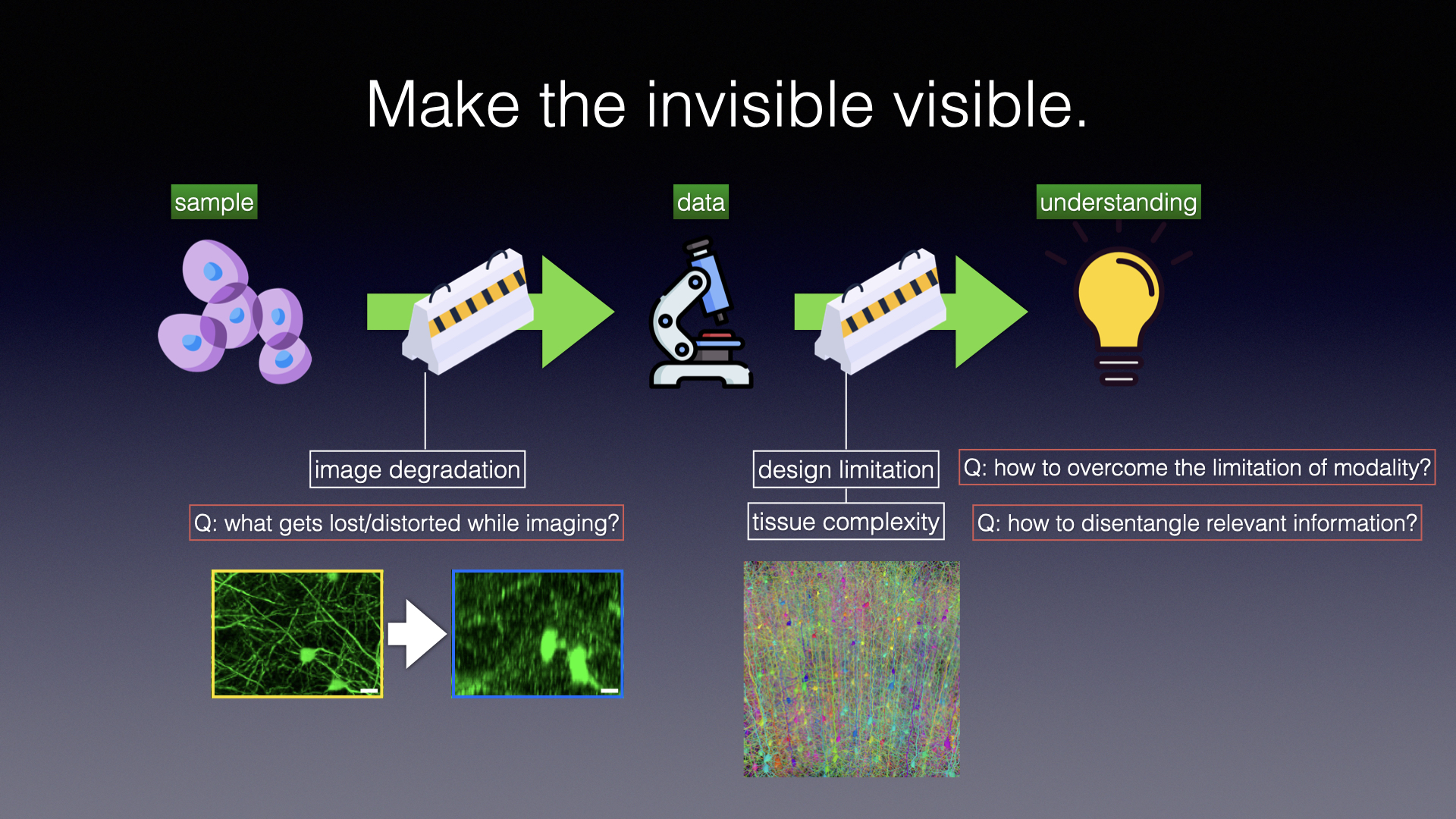
I am a neuroscientist who is passionate about seeing beyond the physical limitations of our instruments to arrive at a new biological discovery. To achieve this, I use deep learning to enhance the signal processing and reconstruction of image data.
Why use deep learning? When we image biological tissue, data gets lost or distorted by a complex mixture of factors, which are often difficult to unravel. Deep learning is an effective and flexible solution searching method for such tasks, especially ill-posed problems. So far, my research has been in fluorescence microscopy. In my latest project, I have implemented a novel unsupervised learning method to achieve isotropic resolution for volumetric fluorescence microscopy without any external references or prior information about the imaging conditions; we only train and test with one sample. I am interested in branching out to other modalities and further testing and developing this framework: e.g., medical imaging modalities and holotomography.
Where I was
I received my bachelor’s degree in Brain and Cognitive Sciences at the Massachusetts Institute of Technology (MIT), and I received my master’s degree in Neural Systems and Computation at ETH Zürich and University of Zürich. I did my master thesis work under the supervision of Dr. Marcel Oberlaender at the Max Planck Institute of Neurobiology of Behavior. After finishing my master’s degree, I returned to my home country (South Korea) due to conscription as a South Korean citizen. I was fortunate enough to work in scientific research to fulfill three years of mandatory military service. For the last three years, I have worked as a research scientist at the Bio-Imaging, Signal Processing & Learning Lab under the guidance of Prof. Jong Chul Ye at the Korea Advanced Institute of Science and Technology (KAIST). I was part of a multi-institutional initiative to lay technical foundations for South Korea’s connectome project. As the project manager of my research division, I spearheaded the development of deep learning methods to enhance microscopy resolution and automate the segmentation of neuronal populations. This project helped me mature into an independent researcher with an interdisciplinary background in neuroscience and deep learning.
Where I am
I have successfully finished the military service and research projects at KAIST, and I look forward to doing more research! I am planning to move back to Europe to pursue a doctoral program. If you share my research interests, I will be happy to connect.